
July 19, 2026 (Gregorian calendar/7th month/Day 199)
Sunday, 12 Hamle 2018 (Ethiopian calendar/11th month)
Ḏabaḥ (Zabah) בח 26 (Enochian calendar/4th month/Offering of produce)
4 July, 2026 (International Fixed calendar)
Cosmic Moon 13, Seli 23 (13 Moon calendar/Waxing Crescent moon)
~ Cosmic Turtle Moon of Presence, June 27th – July 24th
Holly Moon: July 8 – August 4 (Celtic 13 Month Tree calendar)
Month of the Ripe Corn Moon…Gu ye quo ni (Cherokee Moon)
canpasapa wi…moon when the chokecherries are black (Lakota Moon)
13.0.13.13.18 9 Etznab 11 Xul (Mayan Long Count calendar)
stick out your tongue day
(Internet imagine)
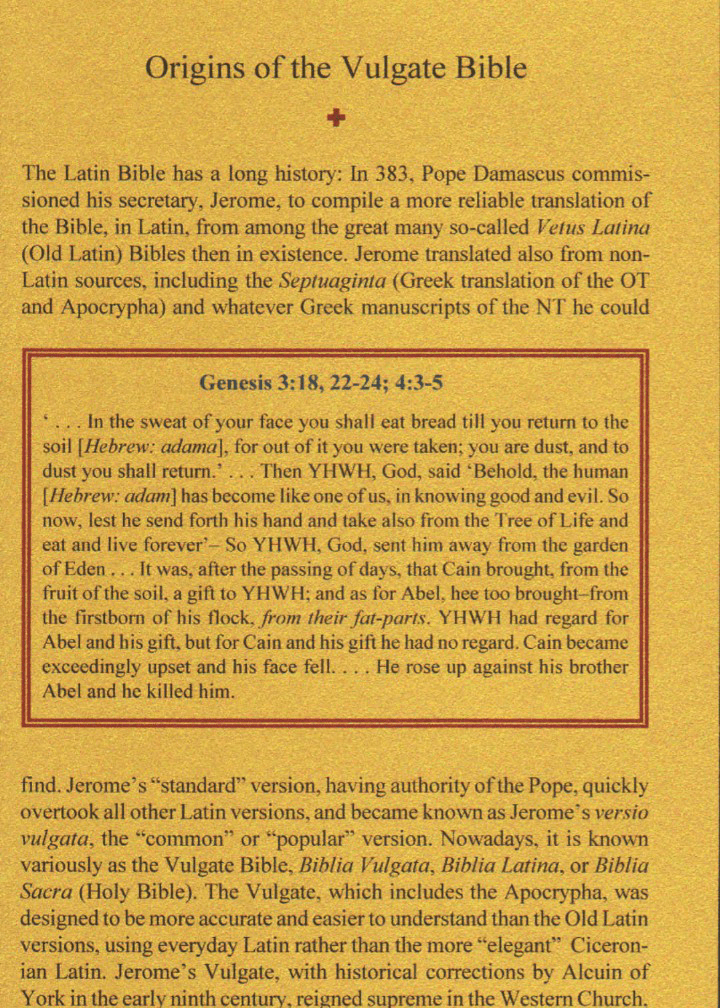
Origins of the Vulgate Bible
+
The Latin Bible has a long history: In 383, Pope Damascus commis-sioned his secretary, Jerome, to compile a more reliable translation of the Bible, in Latin, from among the great many so-called Vetus Latina (Old Latin) Bibles then in existence. Jerome translated also from non-Latin sources, including the Septuaginta (Greek translation of the OT and Apocrypha) and whatever Greek manuscripts of the NT he could find. Jerome’s “standard” version, having authority of the Pope, quickly overtook all other Latin versions, and became known as Jerome’s versio vulgata, the “common” or “popular” version. Nowadays, it is known variously as the Vulgate Bible, Biblia Vulgata, Biblia Latina, or Biblia Sacra (Holy Bible). The Vulgate, which includes the Apocrypha, was designed to be more accurate and easier to understand than the Old Latin versions, using everyday Latin rather than the more “elegant” Ciceron-ian Latin. Jerome’s Vulgate, with historical corrections by Alcuin of York in the early ninth century, reigned supreme in the Western Church.
Genesis 3:18, 22-24; 4:3-5
In the sweat of your face you shall eat bread till you return to the soil [Hebrew: adama], for out of it you were taken; you are dust, and to dust you shall return.’… Then YHWH, God, said ‘Behold, the human [Hebrew: adam] has become like one of us, in knowing good and evil. So now, lest he send forth his hand and take also from the Tree of Life and eat and live forever’- So YHWH, God, sent him away from the garden of Eden… It was, after the passing of days, that Cain brought, from the fruit of the soil, a gift to YHWH; and as for Abel, hee too brought-from the firstborn of his flock, from their fat-parts. YHWH had regard for Abel and his gift, but for Cain and his gift he had no regard. Cain became exceedingly upset and his face fell…… He rose up against his brother Abel and he killed him.
What Is the Vulgate? The Latin Bible That Shaped Christianity
The Vulgate is the Latin translation of the Bible that became the standard scripture text for the Western Church.
The name comes from the Latin word vulgata, meaning “common” or “widely used,” because it was the Bible read and copied across medieval Europe.
Most people use the term to mean the Latin Vulgate associated with Jerome, the late fourth- and early fifth-century scholar who revised and translated biblical books into Latin.
Over time, the Vulgate became the dominant biblical text in the Roman Catholic tradition and a major source for theology, liturgy, canon law, and education.
~ Before Jerome’s work, Christians in the Latin-speaking world relied on a patchwork of older Latin Bible translations known collectively as the Old Latin or Vetus Latina
~ these texts varied widely in wording, quality, and consistency
~ Pope Damasus I asked Jerome to produce a more reliable Latin biblical text
~ in an era when manuscript copying introduced many differences, a standardized Bible was a practical necessity
~ Jerome, also known as Saint Jerome, was one of the great scholars of early Christianity
~ he was deeply fluent in Latin, Greek, and Hebrew, and he spent years studying biblical texts, language, and interpretation
~ his translation work made him unusually important in Christian intellectual history
source: https://encouragingbibleverses.org/what-is-the-vulgate/
a list of books in the Vulgate Bible:
~ Genesis
~ Exodus
~ Leviticus
~ Numeri (Numbers)
~ Deuteronomium (Deuteronomy)
~ Josue (Joshua)
~ Judicum (Judges)
~ Ruth
~ Samuhel (Samuel)
~ Regum (Books of Kingdoms, or Books of Reigns)
~ Paralipomenon ( books “of things passed over”)
~ Esdrae (Ezra)
~ Nehemiae (Nehemiah)
~ Tobiae (Tobit)
~ Judith
~ Esther
~ Job
~ Psalmi (Psalm/Psalms)
~ Proverbia (Proverbs)
~ Ecclesiastes
~ Canticum Canticorum (Solomon’s Song of Songs)
~ Sapientia (?)
~ Ecclesiasticus
~ Isaias (Isaiah)
~ Jeremias (Jeremiah)
~ Lamentationes (Lamentations)
~ Baruch
~ Ezechiel
~ Daniel
~ Osee (Hosea)
~ Joel
~ Amos
~ Abdias (Obadiah)
~ Jonas
~ Michaea (Micah)
~ Nahum
~ Habacuc (Habakkuk)
~ Sophonias
~ Aggaeus (Haggai)
~ Zacharias
~ Malachias (Malachi)
~ Machabaeorum (The First Book of Maccabees)
~ Novum Testamentum (New Testament)
– Secundum Matthaeum
– Secundum Marcum
– Secundum Lucam
– Secundum Ioannem
– Actus Apostolorum
– Ad Romanos
– Ad Corinthios I
– Ad Corinthios II
– Ad Galatas
– Ad Ephesios
– Ad Philippenses
– Ad Colossenses
– Ad Thessalonicenses I
– Ad Thessalonicenses II
– Ad Timotheum I
– Ad Timotheum II
– Ad Titum
– Ad Philemonem
– Ad Hebraeos
– Epistula Iacobi
– Epistula Petri I
– Epistula Petri II
– Epistula Ioannis I
– Epistula Ioannis II
– Epistula Ioannis III
– Epistula Iudae
– Apocalypsis Ioannis
here is an example from Secundum Matthaeum:
| Evangelium Secundum Matthaeum – Chapter 1 |
| The Gospel According To Matthew |
- liber generationis Iesu Christi filii David filii Abraham
The book of the generation of Jesus Christ, the son of David, the son of Abraham: - Abraham genuit Isaac Isaac autem genuit Iacob Iacob autem genuit Iudam et fratres eius
Abraham begot Isaac. And Isaac begot Jacob. And Jacob begot Judas and his brethren.
source: https://vulgate.org/
It does translate for you if you want to explore, but I will definitely be digging further into some of this.
I may or may not be adding this to my Bible list. We all know how I like language and different translations.
hope you have a great day!
thanks for stopping by!!
 Holly'sWorld2.0
Leave a Reply