
August 17, 2026 (Gregorian calendar/8th month/Day 228)
Monday, 11 Nehase 2018 (Ethiopian calendar/12th month)
Karar (Karar) כרר25 (Enochian calendar/5th month/Heat of summer)
5 August, 2026 (International Fixed calendar)
Magnetic Moon 1, Seli 23 (13 Moon calendar/Waxing Crescent Moon)
~ Magnetic Bat Moon of Purpose, July 26th – August 22nd
Hazel Moon: August 5 – September 1 (Celtic 13 Month Tree calendar/9th month)
Month of the end of Fruit Moon…Ga lo ni i (Cherokee Moon)
wasutoa wi: moon of the ripening (Lakota Moon)
13.0.13.15.7 12 Manik 0 Mol (Mayan Long Count calendar)
balloon airmail day, in 1945 – The Animal Farm by George Orwell first published
A Norse werewolf story
– Sigmund and Sinfjotli –
~ mythology unleashed ~
…a 10 minute video
“Following the death of his father and brothers, Sigmund, the son of Volsung, is an outlaw with a desire for vengeance against his brother-in-law, King Siggeir. When he and his son, Sinfjotli, pilfer a pair of magical wolf pelts, they are granted a form of lycanthropy, and become werewolves! For 10 days, the duo decimate Siggeir’s surrounding kingdom…but could the price for such a ruthless power be too steep?” (mythology unleashed)
~~~~~**~~~~~
The Wulver
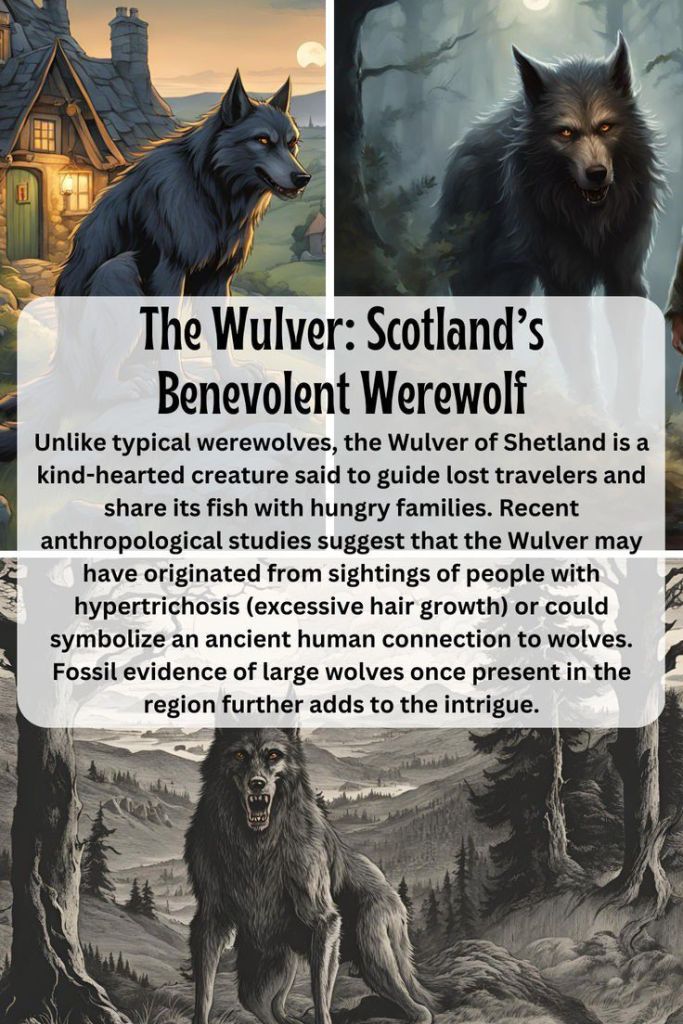
(pinterest)
Scotland’s Benevolent Werewolf
Unlike typical werewolves, the Wulver of Shetland is a kindhearted creature said to guide lost travelers and share its fish with hungry families. Recent anthropological studies suggest that the Wulver may have originated from sightings of people with hypertrichosis (excessive hair growth) or could symbolize an ancient human connection to wolves. Fossil evidence of large wolves once present in the region further adds to the intrigue.
Name pronunciation: Wool‑ver
General Information:
“The Wulver is a wolf‑headed humanoid said to live on the Shetland Islands in Scotland. It is often described as a kind and generous creature, unlike the violent werewolves common in folklore. Though it resembles a werewolf, the Wulver does not change shape and is not affected by the phases of the moon.
“Local stories portray it as a peaceful being that keeps mostly to itself but occasionally helps humans. The Wulver is said to fish in coastal waters, leaving some of its catch for poor families or lost travellers. Recent research, however, suggests the myth may have modern origins rather than being an ancient Shetland belief.”
Appearance:
~ the Wulver is described as a creature shaped like a man but covered in short brown fur, with the head of a wolf
~ standing upright, it has human‑like hands and a strong build
~ despite its frightening appearance, it is not regarded as dangerous
~ its face is often imagined as calm or intelligent, not snarling or beastly
Habitat:
“According to tradition, the Wulver lived in a cave dug into the side of a hill, about halfway up the slope. In Shetland lore, there is even a spot known as the “Wulver’s Stane”, a rock out in deep water where the creature was said to sit for hours, fishing for sillaks and piltaks (types of fish). This connection with the coast and open water shows the Wulver as a solitary yet peaceful part of its landscape.”
Behaviour:
~ the Wulver is known for being kind‑hearted and generous
~ it fished regularly and was believed to leave a few of its fresh catches on people’s windowsills, especially for poor families
~ it would also guide lost travelers back to safety
~ the Wulver did not harm anyone unless provoked, suggesting that it valued peace and respect
~ these traits make it a unique figure among wolf‑type beings in myth
Shape-shifting Ability:
~ unlike a werewolf, the Wulver cannot and does not transform
~ it is said to have always been part‑man, part‑wolf
~

 Holly'sWorld2.0
Leave a Reply