
August 24, 2026 (Gregorian calendar/8th month/Day 235)
Monday, 18 Nehase 2018 (Ethiopian calendar/12th month)
Ṣaḥḥīym (Tsahim) 2צחים (Enochian calendar/6th month/Shining of sun)
12 August, 2026 (International Fixed calendar)
Lunar Moon, Seli 2 (13 Moon calendar/2nd month/Waxing Gibbous Moon)
~ Lunar Scorpion Moon of Challenge, August 23rd – September 19th
Hazel Moon: August 5 – September 1 (Celtic 13 Month Tree calendar/9th month)
Month of the end of Fruit Moon…Ga lo ni i (Cherokee Moon)
wasutoa wi: moon of the ripening (Lakota Moon)
13.0.13.15.14 6 Ix 7 Mol (Mayan Long Count calendar)
international strange music day, Pluto (the planet) demoted day
The Sandown Clown
~ understanding conspiracy ~
…a 15 minute video
“I cover the Sandown Clown (All Colors Sam), first encountered by two children in Sandown, Isle of Wight in May 1973, described as a tall, paper-white, three-digit, clown-robot-alien figure carrying a siren-like device and living in a strange shack, and I recap what it told them about being “not really” human or a ghost. I then discuss folklorist Paul A.T. Wilson’s 2025 announcement that “Faye” provided handwritten transcripts and additional encounters from 1982, 1983, 1984, and 1989, including altered-reality experiences, a warning that kept her from being jailed, and a final meeting where Sam offered a sweet herbal drink and predicted the fall of the Berlin Wall before vanishing. Finally, I argue Sam fits a Nephilim spirit framework—giant traits, evasive answers, future knowledge, and long-term influence—citing Enoch 15:8 and framing the case as deceptive “public image control.” (understanding conspiracy)
chapters:
00:00 Meet the Sandown Clown
00:48 1973 Encounter Recap
01:39 Sam’s Look and Gear
03:24 Hut and Odd Habits
04:10 New Testimony Emerges
04:58 1982 Bus Stop Return
05:22 1983 Reality Shift Vision
05:58 1984 Warning and Rescue
06:57 1989 Tea and Vanishing Hut
08:44 What Was Sam Really
09:21 Nephilim Theory Explained
12:15 Enoch Quote and Agenda
13:48 Wrap Up and Next Steps
~~~~~**~~~~~
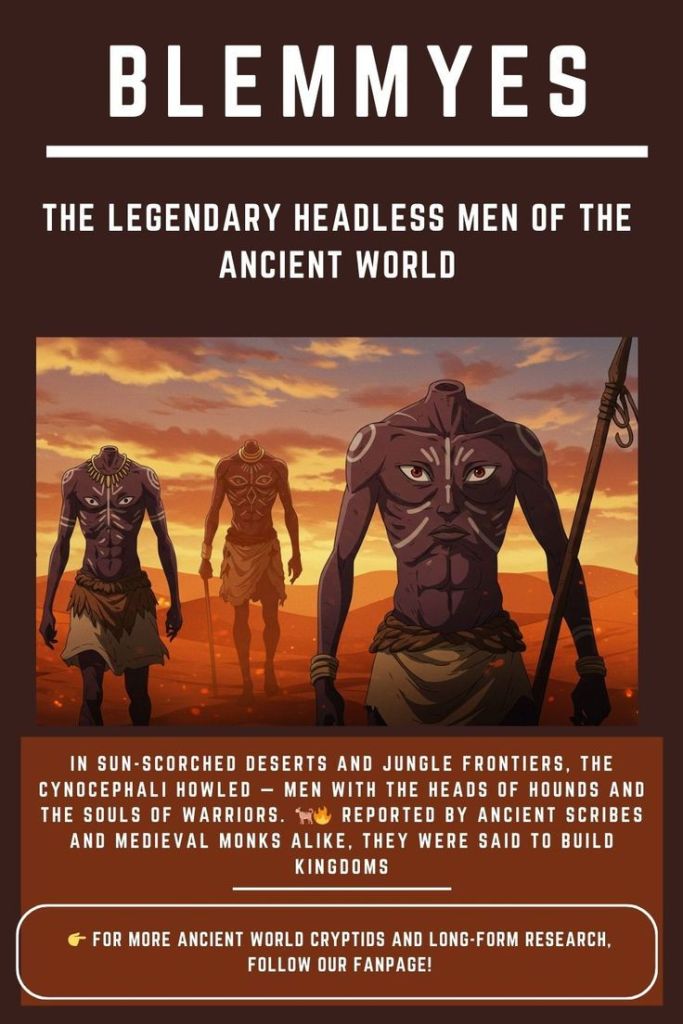
Blemmyes
(pinterest)
The legendary headless men of the ancient world
In sun-scorched deserts and jungle frontiers, the cynocephali howled – men with the heads of hounds and the souls of warriors. Reported by ancient scribes and medieval monks alike, they were said to build kingdoms.
Blemmyes: The Headless Men of Ancient and Medieval Mythology
The Blemmyes are an example of various species of bizarre creatures rumored, in antiquity and later, to inhabit remote parts of the world – from dog-headed humanoids to strange men with a single large foot, and many other weird and wonderful beings.
~ The Blemmyes origins began as a tribe inhabiting the lower parts of Nubia, but later became fictionalized as a race of creatures believed to be acephalous (headless) monsters who had eyes and mouths on their chest
~ the Blemmyes were first described 2,500 years ago in The Histories, written by the 5th century BC Greek historian, Herodotus
~ according to Herodotus, these creatures inhabit the western part of Libya, which is supposed to be “very hilly and thickly wooded, and teems with wildlife”
~ Herodotus, however, does not give these headless creatures of Libya a name
~ the name ‘Blemmyes’ can be found in The Geography of Strabo
~ this 1st century Greek geographer describes the Blemmyes not as strange monsters, but as a tribe inhabiting the lower parts of Nubia, along the Nile towards the Red Sea
~ it is in the work of the Roman writer, Pliny the Elder that we see the Blemmyes of Strabo equated with the headless creatures of Herodotus
~ in the Natural History, Pliny records that “The Blemmyæ are said to have no heads, their mouths and eyes being seated in their breasts”
~ it may be pointed out that like Herodotus, Pliny’s knowledge of the Blemmyes is also based on hearsay
~ Pliny’s view of geography is similar to that of Herodotus, in which the edges of the known world are inhabited by strange creatures. For instance, Pliny also wrote about the Himantopodes, “a race of people with feet resembling thongs, upon which they move along by nature with a serpentine, crawling kind of gait”
~ source: Blemmyes: The Headless Men of Ancient and Medieval Mythology | Ancient Origins
~~~~~**~~~~~
cynocephali
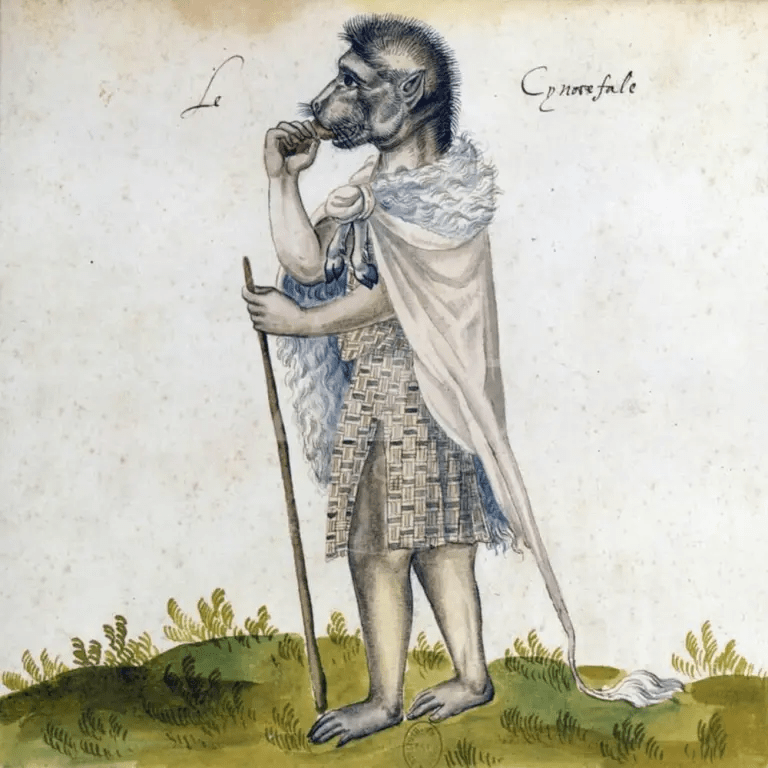
Cynocephali (also spelled cynocephalus) were a legendary “dog-headed” people—humans with canine heads—described in myths and medieval writings. The word comes from the Greek terms for “dog” and “head.”
(search assist)
Cynocephali: The Dog-Headed Men
“Few legends are as intriguing as that of the Cynocephali—the mythical dog-headed men. At first glance, the very notion of a human form with a dog’s head defies belief. In today’s modern world, where fairy tales are dismissed as stories for children, it’s easy to assume such creatures belong solely to the realm of fiction. But the Cynocephali bridge a fascinating gap between myth, legend, and history, representing beings said to hunt, communicate, and thrive alongside humans.”
~ hidden within Hereford Cathedral, on the ancient Hereford Mappa Mundi, lies one of the earliest-known maps of the medieval world, a remarkable artifact that depicts not only geographical locations but also mythical beings, including the Cynocephali
~ their appearance isn’t confined to maps alone – they feature prominently in literature, art, poetry, and even religion
~ while the legend often associates them with regions like the Middle East, Libya, India, and Japan, their depiction on the map is positioned differently
(internetimage)
~ throughout history, the Cynocephali divided opinions: some accounts described them as savage, wolf-like beings, embodying primal instincts and raw strength while others painted them as spiritual figures, revered for their wisdom, craftsmanship, and devotion
~ across all stories, they shared common traits: skilled warriors capable of forging their own armor and weapons, navigating the challenges of life just like other “upright” creations
~ Herodotus referenced the Cynocephali in his Histories, placing them among the many strange and wondrous races said to inhabit the remote corners of the world
~ in his Natural History, Pliny the Elder offers a detailed account of the Cynocephali. He situates them in the mountains of India and describing their habits and customs
~ the Greek physician Ctesias, in his work Indica, gives us another account of the Cynocephali, describing them as a warlike people dwelling in the mountains of India
~ in The City of God, St. Augustine considered the existence of the Cynocephali and their place within God’s creation, reflecting early Christian efforts to reconcile such beings with theological doctrine
~ there has long been a tradition of describing dog-headed warriors within armies to instill fear in their enemies. Marco Polo, in his accounts, mentioned the presence of Cynocephali with an interesting reference to Tartaria
~ in Japanese mythology, the Cynocephali are known as “Jinmenken,” or human-faced dogs. These creatures appear in urban legends and are often associated with dark omens or supernatural events. Unlike the Western depiction of Cynocephali, Jinmenken are described as having the body of a dog and the face of a human
~ source: Cynocephali: The Dog-Headed Men | Tartaria Britannica Magazine
hope you have a great day!
thanks for stopping by!!
 Holly'sWorld2.0
Leave a Reply