
August 31, 2026 (Gregorian calendar/8th month/Day 242)
Monday, 25 Nehase 2018 (Ethiopian calendar/12th month)
Ṣaḥḥīym (Tsahim) 9צחים (Enochian calendar/6th month/Shining of sun)
~ Dan is born
19 August, 2026 (International Fixed calendar)
Lunar Moon, Seli 9 (13 Moon calendar/2nd month/Waning Gibbous Moon)
~ Lunar Scorpion Moon of Challenge, August 23rd – September 19th
Hazel Moon: August 5 – September 1 (Celtic 13 Month Tree calendar/9th month)
Month of the end of Fruit Moon…Ga lo ni i (Cherokee Moon)
wasutoa wi: moon of the ripening (Lakota Moon)
13.0.13.16.1 13 Imix 14 Mol (Mayan Long Count calendar)
we love memoirs day
Bloody Mary
~ mysteries of mythology ~
…a 34 minute video
“Say “Bloody Mary” into a dark mirror enough times… and something might stare back at you.
From haunted bathrooms to ancient mirror rituals, this terrifying legend has frightened generations — but science may finally explain why people swear they’ve seen her.
“Who was Bloody Mary really? Was she Queen Mary I of England, the infamous Blood Countess Elizabeth Báthory, the mysterious witch Mary Worth, or the ghost of a murdered girl trapped between worlds? In this Halloween special, we explore the chilling origins of the Bloody Mary legend, the terrifying mirror ritual, ancient divination practices, urban folklore, and the shocking scientific experiments that explain why people really do see faces in the dark. From ghost stories and haunted mirrors to psychology and mythology, this is the dark truth behind one of the world’s most famous urban legends.”
(mysteries of mythology)
CHAPTERS:
00:00 Intro to Bloody Mary
01:37 How to Summon Bloody Mary
05:22 The “Real” Bloody Mary
09:32 Blood Countess
14:16 Mary Worth
19:14 The Murdered Girl: the urban legend
23:01 From Romance to Horror: the “future husband” mirror rite
26:47 Science of the Mirror: Caputo’s strange-face illusion
31:30 Psychology & Adolescence: why this rite survives
~~~~~**~~~~~
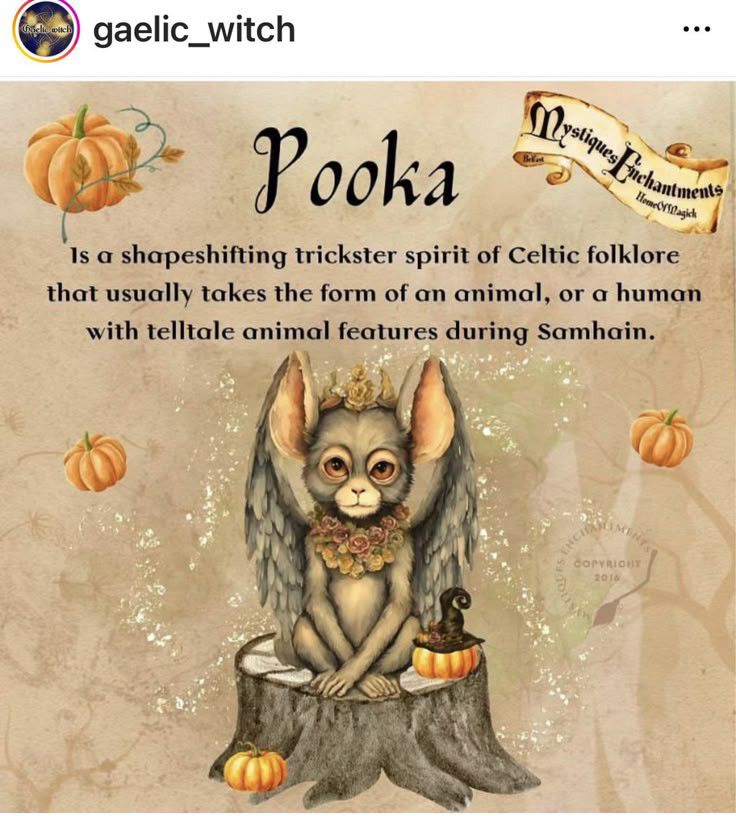
Pooka
(pinterest)
A shapeshifting trickster spirit of Celtic folklore that usually takes the form of an animal during Samhain.
The Púca (Pooka) In Irish Folklore
“The meaning of Pooka, pronounced poo-ka, is from the old Irish word ‘Púca’, which means ‘goblin’.
“There are many variations of the spelling Pooka including Púca, Plica, Phuca, Pwwka, Puka, and Pookha all of which are totally acceptable. It is possible that the origin of the word Pooka may come from the Scandinavian word, Pook or Puke meaning ‘nature spirit’.
What is a Pooka?
~ A Pooka is a mischievous spirit from Irish folklore, often portrayed as taking the form of an animal, such as a rabbit or a horse, and is known for playing tricks on humans
~ in some stories, the Pooka is said to be a benign but mischievous presence, while in others it is portrayed as more malevolent, with the ability to bring harm to those who cross its path
~ the Pooka is also associated with the Otherworld, a realm of magic and mystery in Irish mythology
~ something to remember about a Pooka is that they have the power of human speech and when inclined make great sport of those they talk to as they like to embellish the truth
~ in Ireland, the Púca seems to be the most feared Faerie possibly because it appears only at night and enjoys creating havoc and mischief
~ Pookas can be found in any rural location, every county in Ireland has its very own Pooka. They like open mountainous areas so that they can run free while in horse form
~ many small mountainous lakes and springs in Ireland are called ‘Púca Pools’ or ‘Pollaphuca’, which means Pooka or Demon hole
~ during the Christianization of Ireland, the process of converting the pagan population to Christianity, some of the Pooka Pools were renamed to St. Patrick’s Wells
The drunken horse ride home
When a Pooka is in horse form he tends to have fun by inviting a rider to jump on his back. This usually happens when the rider has had a little too much to drink and is making his weary way home from the pub. Thus starts the wildest trip the rider will ever know for the Pooka loves to terrify the rider with its great prowess jumping over hedges and rocks and making death-defying leaps. Come the grey dawn the rider is thrown off the horse’s back and left trembling but none the worse from the night’s events to find his own way home.
This is maybe where their reputation slips a bit as while on a wild night out like this they do tend to run through crop fields and knockdown fences without care.
A conversation with a Pooka
Another thing the Púca love, as with all Irish people, is to chat and will happily stop and ‘shoot the breeze with you, sometimes giving great advice and making exceptional prophecies.
In some rural areas, you will see houses that will have a bench on the right side of the door and the gate post on the right will be smooth whereas on the left there will be a rockery or some sort of uncomfortable mound. This is because a good Pooka will always sit on the right and the more mischievous sprite will favor the left.
They tend to use the same opening gambit to introduce themselves it will be something like, “You are new here I think. Many years ago I used to live in this house..” One of his favorite topics is how the family lost its fortune or was swindled out of their money and lands.
The Púca’s Share
Mainly associated with Samhain (31st Oct) and November 1st is considered Púca’s Day. This coincides with the harvest and the traditional customs that when the harvest is being brought in the reaper must leave a few stalks behind. This is called the Púca share and must be left to appease the Pooka because we for one would not like to incur his wrath.
It is said that when we see the rain falling on a sunny day, which it does a lot in Ireland, the Púca will definitely make an appearance that night.
Also, berries that have been killed by a frosty overnight should never be eaten as it is the Pooka’s spit that is on them and that would render them poisonous.
The odd thing about a conversation with a Pooka is that you may have sat and chatted to him for an hour but suddenly he disappears. Without saying goodbye, they never say goodbye, you will be left wondering if the past hour was real. They’ll never leave any sign they were there.
Pooka in modern popular culture
The Pooka in all its shapes and forms has made it into many books and films one of the most famous is Harvey the six-foot white rabbit from the play by Mary Chase immortalized in a film by Jimmy Stewart.
~ in the 2001 film Donnie Darko, a Pooka in rabbit form encourages Donnie to do malicious acts which have positive and negative results on the people around him
~ the TV show called Pooka! by Hulu has no connection with the Irish Púca. The TV show character is called Pooka, the year’s most popular Christmas toy with giant glowing eyes and can repeat phrases it hears. It is not part of Irish folklore
source: Pooka / Púca in Irish Folklore – Legends in Irish Mythology
hope you have a great day!
thanks for stopping by!!
 Holly'sWorld2.0
Leave a Reply